

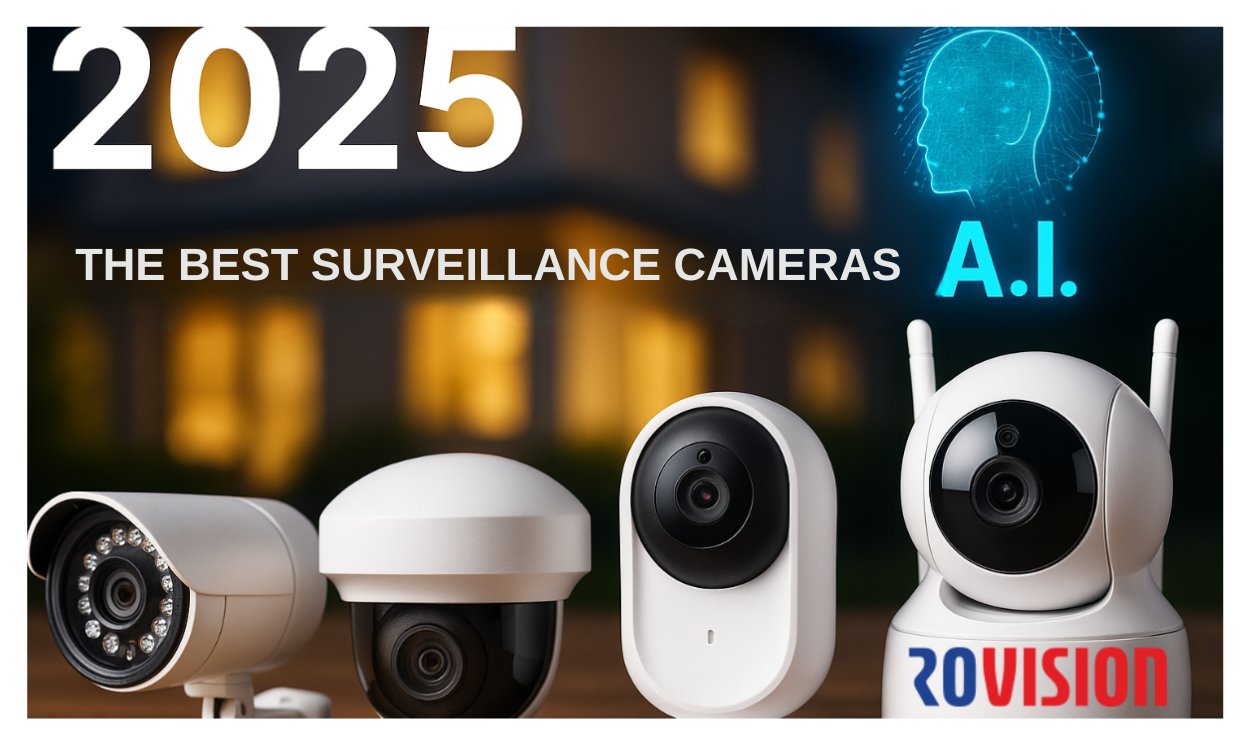
The Best Surveillance Cameras for Home and Business in 2025 Leave a comment
In this article, we will present the best surveillance cameras, both for home use and for business security.
What is A.I.?
In recent years, A.I. — artificial intelligence — has become a topic we hear about everywhere, from smartphones and televisions to cars and, more recently, surveillance cameras. But what does A.I. actually mean?
In simple terms, artificial intelligence is the ability of a computer system to learn, analyze information and make decisions in a way that is similar to human thinking.
A.I., or “Artificial Intelligence”, refers to software programs that can interpret data, identify patterns and even anticipate certain behaviors, without requiring constant human intervention. In 2025, A.I. is no longer just a technology of the future, but an important part of everyday life.
How important is A.I. in 2025?
In 2025, A.I. has become a key factor in improving efficiency, increasing security and automating everyday tasks. Smart surveillance cameras do not simply record video anymore. They can understand what is happening in front of them.
They can detect people, vehicles, animals or suspicious movement and send customized alerts in real time. This makes them much more useful than traditional cameras, especially in situations where fast reaction and accurate information are important.
What are A.I. surveillance cameras? Do they really exist?
Yes, and they are becoming increasingly popular. A.I. surveillance cameras are video security devices that include advanced software for real-time image analysis.
Unlike traditional cameras, which only record video, A.I. cameras can:
- recognize different people through facial recognition;
- detect unusual behavior;
- distinguish between people, animals and objects;
- send smart notifications directly to your phone.
These cameras are already widely used in both residential and commercial environments. They help prevent theft, monitor customer flow and automate access control.
How do A.I. surveillance cameras work?
A.I. cameras are equipped with powerful processors and machine learning algorithms. They analyze video footage as it is captured and compare it with patterns learned previously.
For example, if a person spends too much time near a car in a private parking area, the camera may interpret this behavior as suspicious and send an alert. If a package is left at the entrance of a building and is not picked up, the camera can signal a potential security risk.
This type of intelligent analysis helps reduce false alarms and allows users to focus only on events that truly matter.
What can A.I. cameras do and why are they among the best surveillance cameras?
Choosing an A.I. surveillance camera is a smart decision because of the advanced functions it offers.
Advanced security functions
A.I. surveillance cameras can include features such as facial detection and facial recognition, allowing the system to identify employees, family members or unknown individuals.
They can also provide intelligent alert filtering, so you no longer receive notifications every time a cat walks through the yard. Instead, the system focuses on relevant events, such as people entering a protected area or vehicles moving in a restricted zone.
Another important advantage is real-time monitoring with alerts sent directly to your phone. This means you can receive instant notifications whenever suspicious activity is detected.
For businesses, functions such as people counting and traffic flow analysis are extremely useful. They can help understand how customers move through a store, how crowded certain areas become and how security or operations can be improved.
A.I. cameras can also monitor specific areas of interest, allowing you to choose which part of the image should be analyzed more carefully.
Commercial applications
For businesses, A.I. surveillance cameras offer several important benefits:
- increased security with less stress;
- lower operational costs;
- improved customer service, especially in retail;
- remote control and monitoring, including through mobile applications.
In commercial spaces, these cameras can help prevent theft, improve staff efficiency and provide a clearer overview of daily activity.
Current pricing
The price of A.I. cameras varies depending on specifications, brand and available functions, such as night vision, optical zoom, cloud storage and advanced analytics.
You can view A.I. surveillance cameras here:
https://rovision.ro/categorie-produs/camera-supraveghere/?tehnologie-ai=acusense,wizsense
How to choose the right A.I. surveillance camera
1. Define the purpose
Before choosing a camera, it is important to understand exactly what you need it for.
Do you want to monitor a yard? Do you need indoor surveillance? Is the system intended for a high-traffic business location or for a holiday home?
Each situation requires a different type of camera, so the correct choice starts with a clear understanding of the area that needs to be protected.
2. Choose the right resolution
Resolution is one of the most important factors when choosing a surveillance camera.
Full HD, also known as 1080p, is the minimum recommended resolution for clear images. For larger areas or situations where fine details are important, 2K or 4K cameras are recommended.
A higher resolution can make a significant difference when you need to identify faces, license plates, packages or other important details.
3. Check the A.I. functions
When choosing an A.I. camera, it is important to check what intelligent features it includes.
Some of the most useful functions are:
- facial detection;
- motion alerts;
- human and animal differentiation;
- virtual line crossing for intruder detection.
These features help the camera understand the scene better and send only relevant notifications.
4. Connectivity
Connectivity should be chosen depending on how and where the camera will be used.
Wi-Fi cameras are often a practical option for home use, especially when you want a simple installation without many cables.
For businesses, LAN or PoE cameras are usually recommended. PoE, or Power over Ethernet, allows both power and data transmission through a single network cable, offering better stability and a cleaner installation.
5. Storage options
Surveillance footage can be stored in several ways.
Cloud storage is convenient, but usually requires a subscription. SD card storage can be useful for standalone cameras or smaller installations. For larger systems, an NVR or DVR is generally the best option, especially when multiple cameras need to be recorded continuously.
Smart cameras versus traditional cameras
The main difference between smart cameras and traditional cameras is their ability to analyze what they see.
Traditional cameras record video and sometimes include basic motion detection, but they cannot understand the context of an event. A.I. cameras, on the other hand, can analyze behavior, identify people, distinguish between humans and animals and send relevant notifications.
Smart cameras also allow control through modern mobile applications, while traditional systems may have limited functions or depend on additional equipment in order to be truly efficient.
In short, A.I. cameras are smarter, more efficient and more useful in real security scenarios, both for homes and for businesses.
How to correctly choose A.I. surveillance cameras for your home or business
When choosing an A.I. surveillance camera for your home or business, it is important to remember that different needs require different solutions.
A. For residential use
For indoor monitoring, you can choose smart cameras with sound detection, baby crying detection or even flooding detection, depending on the model and available features.
For perimeter protection, it is recommended to choose cameras with perimeter detection and night vision. These features help protect yards, entrances, garages and other outdoor areas.
Simple mobile applications are also very important for home users, because they allow full control from the phone, from anywhere.
For residential spaces, design can also matter. Compact and discreet models are often preferred because they integrate more easily into the home environment.
B. For business use
For businesses, extended monitoring is usually required. 4K cameras, wide-angle lenses and PoE connectivity are recommended for stable and detailed surveillance.
Facial recognition can be used for access control, helping automate employee entry and improve security.
Behavioral analysis is also useful for preventing theft and optimizing customer activity, especially in retail spaces.
A complete smart security system can also integrate surveillance cameras with alarm systems and access control solutions.
Conclusion
In 2025, A.I. surveillance cameras are among the best options for protecting your home and business. They do not only record. They understand, analyze and react.
In a world where technology is everywhere, investing in an intelligent surveillance system is becoming a necessity, not a luxury.
Whether you want to protect your home or improve the security of your business, A.I. cameras offer a modern, efficient and reliable solution.
Choose smart. Choose safety. Choose the future.